
I was heartened to see someone attempting to grapple with the subgenre of dungeon synth a few days ago (and this short piece is somewhat a response to it). The subgenre is a fascinating microcosm that is of its time in the digital world, a product of the tape-sharing days of the early black metal scene (ca. the late ‘80’s to the mid-‘90’s), and beholden to an historical imaginary (most usually the medieval period). It is, thus, somewhat curiously out of step with just about everything, temporally speaking. Musically, this is the case as well, as it draws from influences ranging from European hymnody, early video game music, and black metal. Some hallmarks of the genre are the heavy or exclusive use of synths and simple, repeated melodies. Normally released on tapes (though the number of digital-only albums grows apace), the aesthetics can range from straight cribs of artwork depicting the fantastical historical imaginary (curiously, many of these come from the 19th or 20th centuries) to nearly childlike designs (as is the case with Jashlykk and Soy Fan Del Dark); frequent motifs are mountains, goblins, dragons, castles (hence the “dungeon” moniker), and so on and so forth.
If this sounds like a digital fever dream version of Romantic aesthetics that fits right in with our technofascist age, that’s because it frequently is. The author of the above article claims that “it would be beneficial for dungeon synth artists to be open about their apoliticality,” but I think this frames the question and the problematic incorrectly. First of all, the notion of apolitical artistic creation and cultural consumption must be rejected out of hand. Even if there were such a thing as an “apolitical standpoint,” that locus would still have its place on the political spectrum. Art is not created in a vacuum; it is embedded in society, which it both reflects and refracts. If one yearns for a fantasy or an historical imaginary means that one finds the contemporary world insufficient for one or another reason; art created with this in mind would reflect these insufficiencies. The aesthetic motifs that are on display would therefore be indicative of either a diagnosis and/or a prescription. Take this as an example inspired by a recent dungeon synth release from the Netherlands (see below): ‘there is too much modernity, and we need to maintain a more magical view of the world.’ Obviously, this is too hasty, but it’s important to delineate a basic understanding of the dialectical relationship between art and society.

On the part of the consumer, the situation is no less complicated, given the nature of the “album” as a commodity. The ‘ethics’ (though I hesitate to use that term) of consumption are fraught, but there are some basic guidelines that I follow. First of all, one must consider that we are living in the age of the death of the author – one thing that Theodor Adorno, my major influence for the previous paragraph, never really picked up on. The intentions of the author are more or less irrelevant. This is why it makes sense to compare certain tonally ‘strange’ avant-garde metal albums to post-bop jazz, as I did here; on the basis of their phenomenological apprehension, they both contain similarities, most especially in their rejection of much of the Western history of music’s harmonic foundations. (Seen in this light, dungeon synth might be roped into the history of minimalism in the latter half of the 20th century. Certainly, it shares more formal similarities to, say, Terry Riley’s keyboard works, than its “direct” influence, black metal.)
Does this mean the consumer can breathe free? There is nothing binding them to the creator of the work of art? Not quite. Personally, I deeply enjoy the music of Burzum, and I think that the project is responsible for some of the most interesting music of the past several decades. Filosofem is a masterpiece. Varg Vikernes, the man behind it, however, is a horrible, racist, murdering shitbag – a term I do not use lightly. Plenty of art that we enjoy in museums and elsewhere was created by racists, murders, etc. Those pieces are, crucially, free or at least accessible and reclaimed by the public sphere. Picasso was by all accounts a deeply sexist man, who drove his lovers and wives to the brink or further, but, when we enjoy one of his pieces in a museum, we are not giving him money, nor are we supporting his worldviews. So when I want to listen to Burzum but I don’t want to fund Varg Vikernes’ bizarre compound and anti-Semitic youtube channel, I find ways to do it that do not give him money. (This has become a lot easier in the age of the internet.)
Now, this may have seemed liked a digression away from the subject matter of dungeon synth, but it is important to establish the political stakes involved here in the consumption of art. Instead of insisting on a non-existent apolitical status, we should inquire as to precisely what the politics of dungeon synth are. Since the subgenre, like all movements, is exceptionally broad, no blanket judgments can be rendered. However, we can be sure to find vulgar Romanticism reactionay. By “vulgar Romanticism,” I mean that which is unaffiliated with the great Romantic thinkers and functions according to a language of fetishes – nature, land, national myth, local character – that frequently have no basis in reality, such as the mystical perversions of German mythology by (the sadly under-studied) Guido von List or the more well-known “peregrinations” of Blavatsky. This was the case of much of the German nature movement of the early 20th century, which provided a not insignificant amount of its mythology to Nazism, and it is the contemporary case of the use of runic writing in modern far right movements, to say nothing of their largely imagined views of a homogeneous past. These appropriations are, historically speaking, actively wrong. But must we throw out all art that deals with imaginary pasts and fantasy? Naturally, no. (Though, striving for a bit more historical accuracy would, assuredly, be nice; the medieval period was not as much of a patriarchal and homogeneously white time as most would have it.)
Vulgar Romanticism is a constant in the scene, as it is in black metal, too. Black metal has the benefit of its musical methods, which often obscure and pervert the very traditions the artists seek to uphold, much in the same way that conservative Austro-Hungarian author Adalbert Stifter often undermined his own Biedermeier historical position and gestured towards a nearly deep ecological perspective. The simplicity of dungeon synth’s musical elements does not often lend itself to this sort of generous reading, however. While I pointed out, previously, a similarity to Terry Riley’s works, it is important to note that the formal advancements of such an avant-garde figure are, frequently, but not always, absent in dungeon synth, as we will see. There are, though, several elements in a number of projects that can move beyond rote Romanticism and its reactionary politics; we will take as case studies two projects, Jashlykk and Til Det Bergens Skyggene, that manage to push the genre forward in interest ways that do not succumb to such vulgarity.
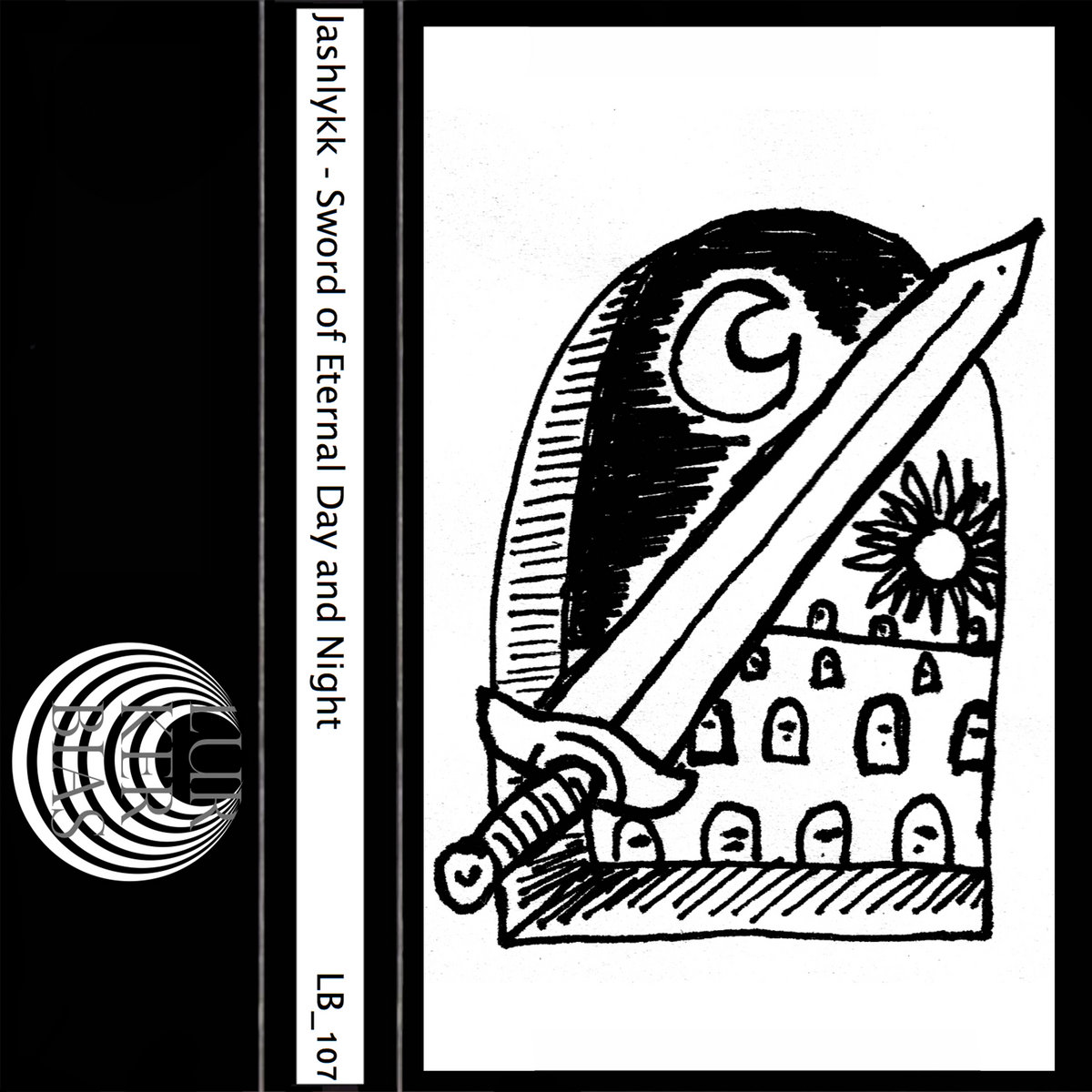
Jashlykk, in Sword of Eternal Day and Night (2018), presents an intriguing fusion of New Age and dungeon synth sounds, placing a great deal of emphasis on building soundscapes. As with many New Age albums, this begins with a field recording of nature, namely a stream, before launching into a simple and repeated melody that follows, predominantly, New Age harmonic structures, favoring the relative high end of the synths. It moves slowly and methodically, creating a sound that can be described as arco and legato. These compositional motifs are consistent throughout the album; for example, the second, third, and outro tracks also use field recordings (notably, of water) to anchor the sound, forming the lowest diegetic level of harmony. Overall, the album feels less like a series of discreet songs and more of a wending path through the woods, underscored, naturally, by the use of field recordings.
Whilst the chordal structures of this album are, in my opinion, better than many dungeon synth releases, particularly those that take influence from video game soundtracks, they are of less interest to us right now than the construction of the album’s soundscape. While my description of the album’s tone as arco and legato may seem to suggest a certain unity, the fact of the albums all-encompassing aesthetic (achieved through drones and the aforementioned field recordings) inherently presents itself as insufficient. This may seem counterintuitive, but, by creating a full soundscape, including natural field recordings, the album undermines the totalizing impulse of the Western tradition of music – namely that it is a discreet world of its own. This tradition, theorized quite well by Lydia Goehr in An Imaginary Museum of Musical Works and the section of Jacques Attali’s Noise that deals with the growth of copyright, is inherently metaphysical and therefore cannot be trusted. By imparting onto music itself a privileged wholeness, we simultaneously shut ourselves off from it. This is simply a reproduction of the Enlightenment mode of thought that animates our contemporary society via the totalizing metanarrative of capitalism (cf. Marx, Derrida on Marx, Adorno), a mimesis of thought that refuses to let us engage with music outside of its status as discreet (which is itself reproduced in the commodity structure). Music, in this viewpoint, becomes the same type of fetish that forms the phenomenology of vulgar Romantic thought.
Jashlykk, in its use of natural field recordings, shows the insufficiency of the idea of music as discreet by gesturing towards the soundscape that constantly surrounds us and its concomitant with any listening experience. Further, the motivic use of water would seem to suggest a view of the world in line with the theories of the pre-Socratic Thales, a fluxing (or flowing) in and out of presencing. The outro closes with a thunderstorm, a rightfully cataclysmic event that would seemingly irrupt across the previously unimpinged skies of metaphysics. In such a way, music cannot function as a fetish (in both the Freudian and Marxist senses), and the metaphysical view of music is, if not overcome by a phenomenological reversal, at least shown to be insufficient. I’ll note here – though not expound upon it due to space constraints – that the album artwork further encourages this sort of chiastic thinking with its heavy use of negative space as constitutive itself, in the same way that the soundscape becomes constitutive of the musical experience.

Whereas Jashlykk moves beyond the metaphysical wholeness of music itself, Til Det Bergens Skyggene (TDBS) can be said to critique music as a commodity. The project does this through a strategic deployment of decay. The project’s first demo (2011) features lengthy meditations on once-again simple melodies, albeit in a darker fashion than Jashlykk, experimenting more deeply with chords that sound “wrong” or “off.” But it’s not just the notes that are wrong – the recordings sound like they were committed to warped tape. In other words, where other dungeon synth groups create a past imaginary, TDBS instantiates itself as past. And, crucially, this past is, itself, insufficient, decayed.
Sites and moments of breakage and interruptions of normal service are topoi of interest. While Theodor Adorno would likely balk at the notion, there is no escaping that, in his essay “Form der Schallplatte” (“Form of the Phonograph Record”), he is engaging in a phenomenological analysis: analyzing the thing qua thing, though he is doing so in an advanced way that takes into account the sedimented views that come after years of inurement in the capitalist system (which is to say ideology). If we are to continue this line of inquiry into the 21st century, we must acknowledge what such a break, caused by years of decay, does to the experience. It is here, if perhaps only in this very specific moment in Adornian thought in the context of contemporary society, that we can bring in the Heideggerian Zeug (tool, roughly) analysis, specifically his famed parable of the hammer. To briefly summarize, one pays attention to the hammer not when it is working, but when it is broken. Only then does it reveal itself to us in its being.The wobbly tape in question, which is “written” and functions according to a logic of writing, is re-written by the passage of time. We are confronted here with a palimpsest of decay. Composing with a tape in this fashion only brings out what was already latent in its form, namely, its capacity for decay and rewriting. And these elements have the radical potential to serve as an irruption of the modern-day life. This break, to return to the Heideggerian schema of phenomenal failure, is where and when ideology’s hold is the weakest, as the permanence that is part of the fetish character of technological commodities is revealed as false. There is, in other words, an interaction with the natural, dare I say, ontological processes which underpin the ideology of capitalism – a reveal that the fetish is itself alive and unfixed.
TDBS’ music is profoundly disruptive. It is daring and atonal, with hints of humanity bubbling only just beneath the surface. This demo is an ode to the submersion of mankind under the yoke of noise, thus a composition of profound pessimism. As the tape wobbles, we feel as though we are on the lake that decorates the cover, again reiterating the motif of water that was present in Jashlykk – except this time, we are not unmasking music’s supposed discreetness as an entity, but the fixity of the commodity object, in this case a tape. The tape is melting and, with it, capitalism’s fixity.
Jashlykk and TDBS both show intriguing methodologies for dungeon synth. As opposed to some of the other acts in the scene, they do not engage in questions of fixity, and they take their fantasy in a metacognitive fashion, engaging in what amounts to two varying paths towards not just self-deconstruction, but rather deconstruction writ large: of music, of the commodity, of capitalism. Whether this is what these artists were intending is beside the point. We have here profoundly critical works that transcend the mere use of fetish objects as a substitute for engaging with heavier questions. In this way, we can begin to think not about what dungeon synth is, but, rather, what it could become; dungeon synth artists don’t have to stop loving goblins, but maybe they can start to love Terry Riley more as well.
 The Camo Pulpit