Don’t
buy into the common refrains that “it won’t be as bad as you think it will”
peddled by endodontists and internet well-wishers. Root canal therapy, commonly
known as just a root canal, is precisely as bad as you are thinking,
unless you have a complete and utter fear of dentists and/or a very over-active
imagination. This, however, should not distract us that it offers us a rare
glimpse into the body’s acoustic interiority. Out of a misplaced belief that it
might make things even a little better, I wore earplugs; this gave me the
advantage of being attuned specifically to the resonances of my body.
The relationship
between the vibration of the teeth and hearing something inside one’s own head
is well-established. In 1916, an article was published in The Electrical
Experimenter outlining how one can, with the help of a sewing needle and a
record you don’t mind destroying, become a sound system; the music of
the record will be reproduced (in snippets) as if it was coming from one’s own
head. A phenomenology of the root canal must proceed from this simple
understanding: the head is a vibratory organ that can also sense these vibrations.
There are
several paths we can take, and we will not take all of them right now. I may
revise this essay in the future when I am not in pain, but it seemed to me necessary
to strike while the iron was hot. First, and most obviously, is that a root
canal draws one’s attention to the fact that we are always receiving vibratory
stimulus in our heads through our teeth, though only rarely do we consider
this. When the outside world is shut out, in my case both by the hermeticism of
the doctor’s office and the ear plugs, it becomes radically apparent how
sensitive the teeth are as instruments of hearing. As the drill vibrates and as
the file wends its way through the inside of the tooth, one is quite literally
forced to confront the poverty of our understanding of the senses on an
everyday level, for one hears an industrial symphony crashing around in one’s
head seemingly without hearing it. This can help us understand how deep
our relationship with the soundscape is, even if we ignore it most of the time.
The
facets of this relationship are further instantiated by the action or
medical process of the root canal: the violent invasion of the bodily self.
Perhaps we can keep the vibrations of the soundscape at bay precisely because we
deem ourselves discreet objects in the world. The thinker Didier Anzieu
theorized this perceived wholeness as the skin-ego. The skin, the outer limit
of the body, is a perceived envelope that separates the ego from the rest of
the world. This perceived separation allows us to view ourselves as a unity,
closed off from the rest of the world, a pure subject the receives unmediated
sensory data. This is, obviously, from breathing and eating upwards, patently
false, but it is a convenient fiction that allows us to maintain our “self,”
the cogito. The surgical procedure of the root canal, for which one is
awake, shows us the lie of this. Not only is the skin violently transgressed by
the phallic instruments,[1]
but even the bones, our deepest point of the discreetness of the self. Our
common boundaries, our ontological grounding as a cogito, is shaken
(literally, as the case is) out of our minds, as we must accede to the will of
the endodontist. Is this not similar to what we are always at risk of with the
soundscape that surrounds us at all points? Instinctually, we know this, for
who hasn’t felt a pang of fear in the depths of the teeth when nails are drawn
across a chalkboard or a drill can be heard erratically in the background of
construction being done?
What a
phenomenology of the root canal can tell us is how precisely we are always potentially
victims of the world surrounding us, always potentially at risk of being
overwhelmed by the soundscape. Even the eardrum is no help, for the vibrations
of the skeleton can communicate just as much to us if we choose to pay it attention.
I do not mean this to be a simple recapitulation to a “cosmic harmony” sort of argument, but rather nuanced view of the “self” and its relationship to the outside world. But perhaps we must reckon with the idea of a worldly, vibratory existence – and its very real implications of sexual violence and neuroses. If Rilke saw the human skull as being akin to the phonograph record, perhaps we out to consider something new for our teeth. Wax cylinders, perhaps – far more easily manipulated than we want?
[1]
And the sexual nature of this sort of surgery should not be ignored. Dental
procedures/torture have long been linked with sexuality, from the religio-sexual
domination of St. Appollonia to the infamous torture scene of Marathon Man.
Exfoliation, as a process of cleaning, is ancient. “Exfoliation,”
in the sense of the word used to refer to this process is also quite old, but
only recently has its dominance as a cosmetological term been asserted. Indeed,
its prominence in this sense coincides with the cosmetology boom of the ‘80’s,
when the Vietnam War was still lodged in the US’s collective consciousness.
What is strange to me is that “exfoliation” became associated with looking
good, feeling good, and general wellness, while defoliation was associated with death, imperialism, war, and
destruction, via Agent Orange. Is exfoliation a guilt-ridden attempt to cleanse
oneself of empire, to subject one’s skin to cleaning? Or perhaps it is an act
of purity? Submerged solidarity?
It should be noted that exfoliation is frequently a slightly painful process. In modernity, cleanliness is often associated with pain; one thinks of Listerine’s “the burn means it’s working” ethos. Yet where Listerine actually has some modicum of health benefits, exfoliation functions purely on the level of the surface (exceptions, naturally, do occur, such as in the case of eczema). It is a superficial cleanliness, a ritual self-negation, a self-subjugation, in order to present oneself as prepared to function in capitalist society. In this sense, it is not an internalization of empire, but a reduction of the self to a subject that can and must be defoliated; in this sense, it is a sort of guilt, a guilt associated with the possibility of a body insufficient for empire. All sense of interiority is flattened out by an obsession with presenting oneself as a commodity; exfoliation, in its association with defoliation, war, and empire, is a symptom of our completely ideological surrender of our bodies, a hope that the body will be enough to overcome the mind.
I wasn’t prepared for my first
encounter when I was probably in the tail end of middle school or the beginning
of high school. I would assume that most people, many of whom were my age, too,
weren’t prepared either when they first saw it. But that’s precisely what underscores
its brilliance. Seldom do we encounter a certain aesthetic something so
startling. As adults, we listen to experimental music knowing that it will be
experimental; we go to museums and galleries with some general idea of what
will transpire. Perhaps it will make us uncomfortable, but this is a discomfort
that is usually within the boundaries of group social experience. It is a rare
experience to be truly jolted out of one’s daily stupor; for me (and probably
for many others), this happened for one of the first times with this piece.
I am speaking, of course, of “B,” which was uploaded to the (in)famous portal for Flash animations, Newgrounds, a site whose influence is now faded but was once one of the powerhouses of the internet experience. Indeed, that one rarely hears Newgrounds discussed in the history of internet aesthetics is, itself, a tragedy. Modern memes as a category were gestated and born there – “All your base are belong to us,” ground zero for a particularly net-bound humor was unveiled there. Part of the reason for the site’s decline is the death of Flash, which, for years, was a major tool for creating and viewing internet art, especially animations. Indeed, Newgrounds was mostly a website for animations; you went there to see dumb shit, usually earnestly animated, like video game parodies or simple sketches. In a word, the pieces you experienced on Newgrounds were durational: they followed a set and usually similar unfolding of time. This is obvious, of course, that, as video art, it opens up onto time, in a way that mirrors our own structuring of time within society and, ultimately, when codified and common, places limits on our quotidian experiences. (One can see the proliferation of TV clips as the gradual meme-ification of the televisual medium.) In other, more broad terms, technology structures our interaction with the world. With video arts, as well as other durational art (such as music as commonly defined), this helps structure and enforce our temporality.
So it’s fascinating and important, especially if one is invested in radical or avant-garde aesthetics, to find points when this breaks down. “B,” simply a white background with a somewhat off-center, red B, is one of those points. From August 15th 2001 on, it has been waiting for people to stumble onto it and assume that Flash was glitching. For it did, indeed, run on Flash just like all the other “animations” in the portal (lately, it seems to have been upgraded as part of an attempt to keep Newgrounds’ archive accessible). It was supposed to run. One expected motion. Even perhaps sound. Indeed, I showed this to a friend a few days ago – “all I’m seeing is a static B.” What we have here/heard is an irruption of technology’s mimetic and auto-mimetic discourse, which allows us to, even if momentarily, consider its mediating effect on our access to the world even at a basic phenomenological level. This is literally instantiated by the work’s refusal to engage in online temporality, which, of course, is generally characterized by its frenetic character. “B” allows for an interruption in the ideological construction and technological mediation of temporality, a moment of self-reflexive negation of its very manifold and milieu.
The piece itself bears striking formal similarities to minimalist art, especially Malevichian suprematism, and surrealist art, the humor of which we often disregard as being insufficiently serious for our cultured selves and which is thus frequently discarded. These movements, however much they attempted to struggle against it, either were at the outset or eventually were recuperated by the bourgeois art world. They were part of the conversation. In contradistinction, “B” is a strange relic from below, in the roiling cauldron of the early days of the internet. It has no connection to the broader art world, and, as far as I know, no connection has ever been alleged. Its status as outsider art allows for it to retain the element of surprise to neophytes, thus its power.
It seems unlikely that “B” has maintained any level of staying power. It stands, at this point, as an artifact of a strange place and a stranger time. But its very existence can point towards artistic practices that still allow us to provoke broader conversations about technology, precisely by means of negation and minimalism. I can’t say how much “B” influenced me; I was already pretty experienced in art and culture at that age, growing up the son of an art history major and the grandson of diplomats with a large collection of contemporary African art. But something about it continues to stick with me. I think it is precisely because my interest in art intersected with my interest in dumb internet shit in such a strange and arresting way. I still haven’t shaken it off. To this day, however, I will argue that it is still one of the greatest pieces of art the internet has ever created. It transcends the art world, upsets temporality, and could only have come completely from below. There is stays. Let’s listen to its muteness and seething rebellion.
Illustration fromGargantua & Pentagruel by Gustave Dore (from Fine Art America)
While browsing at a
“flea market” (read: junk shop) outside a very small town in the mountains of
central Pennsylvania called Avis, which is itself outside a slightly-less-small
town called, for reasons unbeknownst to me, Jersey Shore, I found an old copy of
Rabelais’s Gargantua & Pentagruel, a
favorite of Thomas Jefferson – a factoid that will become more interesting
later. It looked as if it was purchased for a college class many decades ago
and sat accruing dust (and receiving absolutely no second glances). But this
was evidently not the case. When I took my purchase home, a well-folded,
stapled series of papers, presumably used as a bookmark fell out; I was shocked
to see that it contained a sort of manifesto or political screed or maybe even
a draft of a letter to the editor,written
by hand in legible yet shaky letters. (Maybe the author – who did not sign his
or her name – was suffering from DTs or Parkinson’s, but I do not want to
poetically project too much here…) As the note was interesting (and I am an
inveterate lover of ephemera and outsider art, literature, and theory), I have
reproduced it here. It should go without saying that the views expressed are
not necessarily my own; similarly, in instances where the writing was smudged
(the author was almost definitely left-handed), I have used my best judgment to
fill in the gaps. On the off-chance that the original author is alive and
somehow finds their way to this blogpost and then subsequently desires that it
be taken down, I’ll be sure to oblige.
If we
Americans revolt as a result of the difficulties and problems that our current
social fabric is unable to digest, we will discover that our world can cast off
an intolerable bureaucratic tyranny without inventing ever new forms of the
same. We can find in a revolutionary future greater liberty and abundance, just
as the founders did.
“Revolution”
has been tarred and feathered by the experiences of the USSR, China, Cuba, and,
now, Venezuela. We fear that we would fall prey to the same impoverishment and
intolerable cruelty that it brought for these places.
We fear
that our so-called “conservatives” (and “liberals”) might impede us. We fear
that other nations would abandon us – or take advantage of us. We fear that we
would be coerced to take on habits in the food we eat, the way we dress. We
fear famine and a lack of freedom of the press (as if that wasn’t already
inflicted upon us).
We fear
runaway inflation, bureaucracy and the rise of a bureaucratic class, and
endless breadlines in all aspects of our life. We fear soulless standardization
in the arts and sciences. We fear that all our treasured political fits and
starts will be destroyed by those gray bureaucrats. And we fear being forced to
read unending pamphlets about complicated and foggy philosophies that were
never written to be comprehended. We fear, in other words, that modern
revolutionary America will become just another China – at least the China of
our collective imaginations.
Really,
though, the American future I envision can be as different from China and the USSR
as a garter snake from a worm. Yet this future can only come to us through
revolution, just as freedom first came to America. We are a nation of cusses.
We’ll insist on throwing a few barstools. Of course, we’re hunters and anglers
and salts and vets and addicts and mechanics, as Teddy Roosevelt embodied…
we’re wanderers of both ideology and the world, and it’d be right contrary to
our tradition to make such a major change without choosing sides and knocking a
few people on their asses.
But, if
you take a good look at it, the revolution will be insignificant compared to
those in China and Russia. We are a nation of great wealth – and great gaps in
wealth. Revolutions aren’t fought by the handful of men at the top, the 1%. The
plutocrats, with their hands in your pockets, would try to recruit henchmen
from us in the lower classes by showering them with wealth and the ideological
pap of the status quo.
Everybody
– everybody of every gender, race, creed, age, what have you – below these few
is already prepared for a future of renewed community. Addiction, malaise, and
the concentration of wealth has dealt a crushing blow to those who live off the
land, even as they grapple with the realities of crude, soulless agribusiness
and have the right to repair their own equipment taken from them. The revolution welcomes them, for they have
nothing to lose in this modern age.
Who will
oppose today’s Jefferson, Adams, Hale? The mollycoddled rich? Musk, Bezos,
Gates, and their ilk? They could only shrink back once they see our unity.
The people,
the community will take control of those runaway businesses that too often need
the help of Uncle Sam’s pocketbook. Banks, the automakers, telecoms, and so on.
This is
where we can produce real miracles. The elite fever dream of “technocracy” can
come true only after our revolution when we have renewed our covenant as a
community. The most daring proposals to drain the swamp by Trump will seem
childish compared to our coming community.
Henry
Ford invented the production line, and we can take his innovations – still relevant
to this day! – and apply them to the whole of the world, lifting, finally, the
organization of the factory floor from the scorn it draws from the well-to-do
who have never felt grease under their fingers. It will be stupendous.
Costs
will plummet, and, with it, our purchasing power will rise.
We will
grow and work together as the community that was once foreseen by Thomas Paine,
Tocqueville, and, above all, Thomas Jefferson, sharing the wheel of the combine
as we reap our harvest.
When the
people harvest their food and mine their ore, all of our soul-sucking,
meaningless jobs will disappear – without compulsion! They will simply fade away!
We need not fear social engineering; our wealth and well-being are so great in
comparison to those other nations that attempted a revolution. Russia was
filled with illiterate peasants under the yoke of the czar.
Our
oppressors won’t have to be so violently opposed – let us consign them to a
life on Mark Zuckerberg’s Hawaiian island, even give them food.
I
suspect that when America, ever the shining beacon for the world, realizes that
it can control its own destiny, other nations will join us, and our community
will grow. The Monroe Doctrine will finally achieve its potential!
Our
president claims to be against the system. In this, we are in agreement, but we
need a newsystem, one based
around community – a community that can choose for itself.
Our
wealth and technology sit idle, callouses soften, men lay at home because of
the paralysis of the system, choking on itself in the wake of the Recession.
Think of what we could provide for the community if we did not listen to those
gray bureaucrats!
We are
prepared for this like nowhere else in the world! The community will stop
hamstringing itself by pretending that “trade secrets” do anything other than
line the pockets of our corporate owners. Let the community grow its knowledge
together, for we are a nation of great inventiveness, especially when we work together
for our neighbors.
The “radical”
economists who have never lived in the economy are wrong! Money can fade away!
There will be more than enough of everything for everybody!
We have
reached this pinnacle before any other country, blessed by our natural
resources. Because of this, we need not rely on the bureaucrat class to tell us
what to do. Our tastes and habits would never abide that anyhow. As we begin to
work for human needs as opposed to so-called “profit” (for who!), we will
struggle against one another yet more – good!
This is
the basis of democracy! We will be argumentative and vital! The community must
decide for itself how to proceed – where does the new train line go, how can we
protect our infrastructure from decay and dereliction, and so on. This invites
debates and elections.
We would
start more blogs, converse more deeply. As the community refuses to let the
online platforms self-regulate, the financial system would no longer be allowed
to decide what media can be distributed – progressive or reactionary, yellow or
thoughtful, puritanical or subversive. It depends only on time. This is not a
marketplace of ideas – but a true forum!
We can
set aside vast funds for research and invention in every field, from philosophy
and literature to chemistry and astronomy. No longer will Europeans and those
who yearn to be them be able to sneer at us from their decrepit castles. We are
nearing the true dividing line between the Middles Ages and the modern world.
No
longer will we accept their cultural backwash and claim it as our own. For this,
we turn to our writers and philosophers!
We weren’t
ready for the Recession, for the plague of addiction, for automated factories.
We were the world’s superpower, after all. But these hopes have fallen away
likes scales from our eyes, and we can see the toll the relentless pursuit of
profit has taken with every obituary for an overdose, every life winked out of
existence by greed. Growth does not follow a straight line, we must recognize
this.
There is no way to un-see it.
When the Europeans fret about their decaying castles, when people look for someone different to blame for this state of affairs, they are seeking a purity that never existed. Let us, the community of all, take the wheel of our economy and culture and apply our great Americanness to the problems that face us instead of entrusting our lives and the lives of our children and the lives of our neighbors to men and women who just don’t care.
I was heartened to see someone attempting to grapple with the subgenre of dungeon synth a few days ago (and this short piece is somewhat a response to it). The subgenre is a fascinating microcosm that is of its time in the digital world, a product of the tape-sharing days of the early black metal scene (ca. the late ‘80’s to the mid-‘90’s), and beholden to an historical imaginary (most usually the medieval period). It is, thus, somewhat curiously out of step with just about everything, temporally speaking. Musically, this is the case as well, as it draws from influences ranging from European hymnody, early video game music, and black metal. Some hallmarks of the genre are the heavy or exclusive use of synths and simple, repeated melodies. Normally released on tapes (though the number of digital-only albums grows apace), the aesthetics can range from straight cribs of artwork depicting the fantastical historical imaginary (curiously, many of these come from the 19th or 20th centuries) to nearly childlike designs (as is the case with Jashlykk and Soy Fan Del Dark); frequent motifs are mountains, goblins, dragons, castles (hence the “dungeon” moniker), and so on and so forth.
If this sounds like a digital fever dream version of Romantic aesthetics that fits right in with our technofascist age, that’s because it frequently is. The author of the above article claims that “it would be beneficial for dungeon synth artists to be open about their apoliticality,” but I think this frames the question and the problematic incorrectly. First of all, the notion of apolitical artistic creation and cultural consumption must be rejected out of hand. Even if there were such a thing as an “apolitical standpoint,” that locus would still have its place on the political spectrum. Art is not created in a vacuum; it is embedded in society, which it both reflects and refracts. If one yearns for a fantasy or an historical imaginary means that one finds the contemporary world insufficient for one or another reason; art created with this in mind would reflect these insufficiencies. The aesthetic motifs that are on display would therefore be indicative of either a diagnosis and/or a prescription. Take this as an example inspired by a recent dungeon synth release from the Netherlands (see below): ‘there is too much modernity, and we need to maintain a more magical view of the world.’ Obviously, this is too hasty, but it’s important to delineate a basic understanding of the dialectical relationship between art and society.
Vetus Sepulchrum, Journey Afar (2019)
On the part of the consumer, the situation is no less complicated, given the nature of the “album” as a commodity. The ‘ethics’ (though I hesitate to use that term) of consumption are fraught, but there are some basic guidelines that I follow. First of all, one must consider that we are living in the age of the death of the author – one thing that Theodor Adorno, my major influence for the previous paragraph, never really picked up on. The intentions of the author are more or less irrelevant. This is why it makes sense to compare certain tonally ‘strange’ avant-garde metal albums to post-bop jazz, as I did here; on the basis of their phenomenological apprehension, they both contain similarities, most especially in their rejection of much of the Western history of music’s harmonic foundations. (Seen in this light, dungeon synth might be roped into the history of minimalism in the latter half of the 20th century. Certainly, it shares more formal similarities to, say, Terry Riley’s keyboard works, than its “direct” influence, black metal.)
Does this mean the consumer can breathe free? There is nothing binding them to the creator of the work of art? Not quite. Personally, I deeply enjoy the music of Burzum, and I think that the project is responsible for some of the most interesting music of the past several decades. Filosofem is a masterpiece. Varg Vikernes, the man behind it, however, is a horrible, racist, murdering shitbag – a term I do not use lightly. Plenty of art that we enjoy in museums and elsewhere was created by racists, murders, etc. Those pieces are, crucially, free or at least accessible and reclaimed by the public sphere. Picasso was by all accounts a deeply sexist man, who drove his lovers and wives to the brink or further, but, when we enjoy one of his pieces in a museum, we are not giving him money, nor are we supporting his worldviews. So when I want to listen to Burzum but I don’t want to fund Varg Vikernes’ bizarre compound and anti-Semitic youtube channel, I find ways to do it that do not give him money. (This has become a lot easier in the age of the internet.)
Now, this may have seemed liked a digression away from the subject matter of dungeon synth, but it is important to establish the political stakes involved here in the consumption of art. Instead of insisting on a non-existent apolitical status, we should inquire as to precisely what the politics of dungeon synth are. Since the subgenre, like all movements, is exceptionally broad, no blanket judgments can be rendered. However, we can be sure to find vulgar Romanticism reactionay. By “vulgar Romanticism,” I mean that which is unaffiliated with the great Romantic thinkers and functions according to a language of fetishes – nature, land, national myth, local character – that frequently have no basis in reality, such as the mystical perversions of German mythology by (the sadly under-studied) Guido von List or the more well-known “peregrinations” of Blavatsky. This was the case of much of the German nature movement of the early 20th century, which provided a not insignificant amount of its mythology to Nazism, and it is the contemporary case of the use of runic writing in modern far right movements, to say nothing of their largely imagined views of a homogeneous past. These appropriations are, historically speaking, actively wrong. But must we throw out all art that deals with imaginary pasts and fantasy? Naturally, no. (Though, striving for a bit more historical accuracy would, assuredly, be nice; the medieval period was not as much of a patriarchal and homogeneously white time as most would have it.)
Vulgar Romanticism is a constant in the scene, as it is in black metal, too. Black metal has the benefit of its musical methods, which often obscure and pervert the very traditions the artists seek to uphold, much in the same way that conservative Austro-Hungarian author Adalbert Stifter often undermined his own Biedermeier historical position and gestured towards a nearly deep ecological perspective. The simplicity of dungeon synth’s musical elements does not often lend itself to this sort of generous reading, however. While I pointed out, previously, a similarity to Terry Riley’s works, it is important to note that the formal advancements of such an avant-garde figure are, frequently, but not always, absent in dungeon synth, as we will see. There are, though, several elements in a number of projects that can move beyond rote Romanticism and its reactionary politics; we will take as case studies two projects, Jashlykk and Til Det Bergens Skyggene, that manage to push the genre forward in interest ways that do not succumb to such vulgarity.
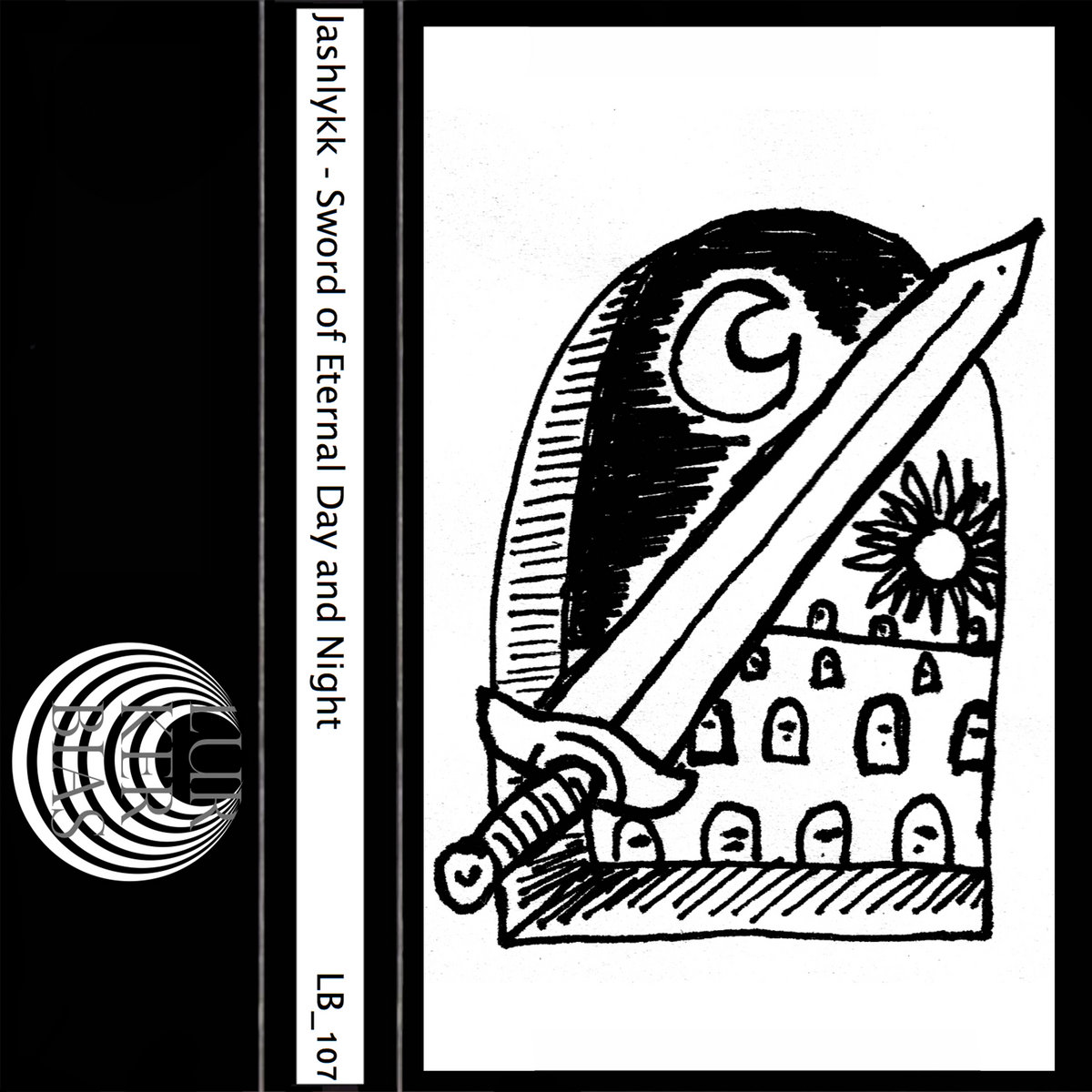
Jashlykk, Sword of Eternal Day and Night (2018)
Jashlykk, in Sword of Eternal Day and Night (2018), presents an intriguing fusion of New Age and dungeon synth sounds, placing a great deal of emphasis on building soundscapes. As with many New Age albums, this begins with a field recording of nature, namely a stream, before launching into a simple and repeated melody that follows, predominantly, New Age harmonic structures, favoring the relative high end of the synths. It moves slowly and methodically, creating a sound that can be described as arco and legato. These compositional motifs are consistent throughout the album; for example, the second, third, and outro tracks also use field recordings (notably, of water) to anchor the sound, forming the lowest diegetic level of harmony. Overall, the album feels less like a series of discreet songs and more of a wending path through the woods, underscored, naturally, by the use of field recordings.
Whilst the chordal structures of this album are, in my opinion, better than many dungeon synth releases, particularly those that take influence from video game soundtracks, they are of less interest to us right now than the construction of the album’s soundscape. While my description of the album’s tone as arco and legato may seem to suggest a certain unity, the fact of the albums all-encompassing aesthetic (achieved through drones and the aforementioned field recordings) inherently presents itself as insufficient. This may seem counterintuitive, but, by creating a full soundscape, including natural field recordings, the album undermines the totalizing impulse of the Western tradition of music – namely that it is a discreet world of its own. This tradition, theorized quite well by Lydia Goehr in An Imaginary Museum of Musical Works and the section of Jacques Attali’s Noise that deals with the growth of copyright, is inherently metaphysical and therefore cannot be trusted. By imparting onto music itself a privileged wholeness, we simultaneously shut ourselves off from it. This is simply a reproduction of the Enlightenment mode of thought that animates our contemporary society via the totalizing metanarrative of capitalism (cf. Marx, Derrida on Marx, Adorno), a mimesis of thought that refuses to let us engage with music outside of its status as discreet (which is itself reproduced in the commodity structure). Music, in this viewpoint, becomes the same type of fetish that forms the phenomenology of vulgar Romantic thought.
Jashlykk, in its use of natural field recordings, shows the insufficiency of the idea of music as discreet by gesturing towards the soundscape that constantly surrounds us and its concomitant with any listening experience. Further, the motivic use of water would seem to suggest a view of the world in line with the theories of the pre-Socratic Thales, a fluxing (or flowing) in and out of presencing. The outro closes with a thunderstorm, a rightfully cataclysmic event that would seemingly irrupt across the previously unimpinged skies of metaphysics. In such a way, music cannot function as a fetish (in both the Freudian and Marxist senses), and the metaphysical view of music is, if not overcome by a phenomenological reversal, at least shown to be insufficient. I’ll note here – though not expound upon it due to space constraints – that the album artwork further encourages this sort of chiastic thinking with its heavy use of negative space as constitutive itself, in the same way that the soundscape becomes constitutive of the musical experience.
Til Det Bergens Skyggene, Demo I (2011)
Whereas Jashlykk moves beyond the metaphysical wholeness of music itself, Til Det Bergens Skyggene (TDBS) can be said to critique music as a commodity. The project does this through a strategic deployment of decay. The project’s first demo (2011) features lengthy meditations on once-again simple melodies, albeit in a darker fashion than Jashlykk, experimenting more deeply with chords that sound “wrong” or “off.” But it’s not just the notes that are wrong – the recordings sound like they were committed to warped tape. In other words, where other dungeon synth groups create a past imaginary, TDBS instantiates itself as past. And, crucially, this past is, itself, insufficient, decayed.
Sites and moments of breakage and interruptions of normal service are topoi of interest. While Theodor Adorno would likely balk at the notion, there is no escaping that, in his essay “Form der Schallplatte” (“Form of the Phonograph Record”), he is engaging in a phenomenological analysis: analyzing the thing qua thing, though he is doing so in an advanced way that takes into account the sedimented views that come after years of inurement in the capitalist system (which is to say ideology). If we are to continue this line of inquiry into the 21st century, we must acknowledge what such a break, caused by years of decay, does to the experience. It is here, if perhaps only in this very specific moment in Adornian thought in the context of contemporary society, that we can bring in the Heideggerian Zeug (tool, roughly) analysis, specifically his famed parable of the hammer. To briefly summarize, one pays attention to the hammer not when it is working, but when it is broken. Only then does it reveal itself to us in its being.The wobbly tape in question, which is “written” and functions according to a logic of writing, is re-written by the passage of time. We are confronted here with a palimpsest of decay. Composing with a tape in this fashion only brings out what was already latent in its form, namely, its capacity for decay and rewriting. And these elements have the radical potential to serve as an irruption of the modern-day life. This break, to return to the Heideggerian schema of phenomenal failure, is where and when ideology’s hold is the weakest, as the permanence that is part of the fetish character of technological commodities is revealed as false. There is, in other words, an interaction with the natural, dare I say, ontological processes which underpin the ideology of capitalism – a reveal that the fetish is itself alive and unfixed.
TDBS’ music is profoundly disruptive. It
is daring and atonal, with hints of humanity bubbling only just beneath the
surface. This demo is an ode to the submersion of mankind under the yoke of
noise, thus a composition of profound pessimism. As the tape wobbles, we feel
as though we are on the lake that decorates the cover, again reiterating the
motif of water that was present in Jashlykk – except this time, we are not
unmasking music’s supposed discreetness as an entity, but the fixity of the
commodity object, in this case a tape. The tape is melting and, with it,
capitalism’s fixity.
Jashlykk and TDBS both show intriguing
methodologies for dungeon synth. As opposed to some of the other acts in the
scene, they do not engage in questions of fixity, and they take their fantasy
in a metacognitive fashion, engaging in what amounts to two varying paths
towards not just self-deconstruction, but rather deconstruction writ large: of
music, of the commodity, of capitalism. Whether this is what these artists were
intending is beside the point. We have here profoundly critical works that
transcend the mere use of fetish objects as a substitute for engaging with
heavier questions. In this way, we can begin to think not about what dungeon
synth is, but, rather, what it could
become; dungeon synth artists don’t have to stop loving goblins, but maybe
they can start to love Terry Riley more as well.
Dream of Evil by Georg Trakl translated by James M. Kopf
Echoes away, the gong’s browngolden blasts A lover in a darkened chamber jolts Cheeks aflame, glittering on the window bolts. Against the storm crackle sails, cordage, masts.
A monk, a pregnant woman there in the drama. Guitars astrum, red cloaks athrum Sweating chestnuts snug in a golden gleam; Black juts the church of the resplendent trauma.
From out of the bleached mask, eyes the evil spirit. A piazza, obscure, grey, and twilit; In the evening, murmurs arise upon the islet.
The birds scrawl nonsense signs aflight, Read by lepers, who decay in the night. Shuddering in the park, siblings glimpse each other.
De Profundis by Georg Trakl translated by James M. Kopf
This is a stubblefield, on which a black rain falls. This is a brown hardwood, which there stands alone. This is a sibilant wind, which encircles the vacant chalets. How dreary this evening.
Past the hamlet, Still the gentle orphan gathers meager cobs. Her eyes survey, round and gilt in the gloaming, And her creel awaits the heavenly bridegroom.
On the path home, The shepherds found the sweet corpse, Rotting away in the bramble.
Whenceforth darkened villages, I am a shadow. God’s silence Drank I from the copse’s burn.
My brow meets with cold metal. Spiders seek my heart. This is a light, which smothers my mouth.
In the night, I found myself upon a heath, Teeming with trash and stardust. In the hazelbush, Sound crystal angels once more.



 The Camo Pulpit